

Commonly Used Terms for Gas Detection Applications
- PPM: Part(s) Per Million
A unit of concentration, pertaining to a gas mixture, defined as the ratio between the volume of an individual component Vi and the total volume Vtotal :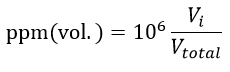
10,000 parts per million equals one percent. Other concentration units are discussed here. - LEL: Lower Explosive Limit
The lowest concentration of a gas in air, which, when ignited, will sustain combustion. [LELs for many gases of interest] - TLV: Threshold Limit Value
This refers to airborne concentrations of substances, and represent conditions under which nearly all workers may be repeatedly exposed day after day without adverse health effects. “TLV” is a trademark of the American Conference of Governmental Industrial Hygienists.
There are three categories of TLVs
- TLV – TWA: Time Weighted Average
This refers to a time weighted AVERAGE concentration for a normal 8 hour day, in a 40 hour work week in which MOST workers can be exposed REPEATEDLY without adverse effect. - TLV – STEL: Short Term Exposure Limit
This is the concentration in which most workers can be exposed CONTINUOUSLY for a SHORT period of time without suffering from irritation, chronic or irreversible tissue damage, or narcosis to the degree which would impair self rescue, work efficiency or cause accidents, PROVIDED that the TWA has not been exceeded. Further, a STEL is a 15 minute TWA which should not be exceeded any time during a normal work day even if the worker is within the 8 hour TWA. Exposures ABOVE the TWA and UP TO the STEL should not be longer than 15 minutes and should not exceed 4 times a day. - TLV – C: Ceiling
This is a concentration which should not be exceeded during any part of the working exposure.
OSHA has promulgated PELs (Permissible Exposure Limits) for many substances, and these have the force of law behind them. In general, the PELs are 8-hour time weighted averages, but ceiling limits have been established for some chemicals. 29 CFR 1910.1000 Table Z-1 details these values. In certain cases—such as ethylene oxide—this table refers to a separate section within 29 CFR 1910.
Per 29 CFR 1910.1000(a)(1), the Ceiling Value sets a concentration which shall at no time exceed the exposure limit given for that substance. If instantaneous monitoring is not feasible, then the ceiling shall be assessed as a 15-minute time weighted average exposure which shall not be exceeded at any time during the working day.
The OSHA Action Level—calculated as an eight (8)-hour time-weighted average (and generally lower than the PEL)—is a concentration designated for specific substances listed in 29 CFR part 1910 that initiates certain required activities such as exposure monitoring and medical surveillance. [29 CFR 1910.1450(b)]. Historically, unless otherwise specified, the Action Level is set to one-half of the PEL.
NIOSH issues its RELs (Recommended Exposure Limits), as well. The OSHA standards and NIOSH guidelines are often, but not always, in harmony with the ACGIH TLVs. Similar bodies exist in other countries. It is prudent to consider the recommendations of all relevant agencies, before formulating your occupational health strategy.
Application Types
- Workplace Monitoring
refers to measuring the work environment (generally indoors), for monitoring worker safety, for OSHA compliance or industrial hygiene surveys. The appropriate instrumentation to be recommended in this case are monitors designed with the intent to be sensitive, and accurate to address TLV levels and below. Generally these monitors are NOT designed to measure high concentration levels. It may be of interest to monitor combustible gases in the workplace, to make sure that their concentrations are well below the LEL. - Process Monitoring
refers to an application where a constant stream of gas will be present. In most of these cases, the customer will want to measure a change in the gas concentration, for process control, rather than personnel safety reasons. - Stack Monitoring
applications refer to monitoring stack emissions, to meet EPA compliance.
Further Defining The Application
- Do you need a portable, direct-reading survey monitor for occasional spot check monitoring, or rather a stationary, installed area monitor to operate on a round-the-clock basis?
- Do you simply require a personal alarm device to be worn under certain circumstances?
- What full-scale measuring range is required?
- What other possible gases may be present which could cause a cross interference?
- What type of alarm capability is required? Do you need alarm signaling devices, or merely relay contact closures?
- Would you like data acquisition capability? This can be especially important to fend off lawsuits.
Calibration And Maintenance
All gas detection instruments must be calibrated against a known gas standard, and will have other maintenance requirements. Proper calibration is about 90 percent of successful gas detection. Here is what OSHA says about calibration.
Calibration standards for certain gases may present special difficulties. While many gas standards can be supplied in cylinders, others must be obtained as permeation devices. In fact, several of the most toxic compounds, which need standardization at low concentration, will only be available as permeation devices. And, for some substances, no commercial calibration standard is available. Even with these, we can help.
Check out OSHA’s Technical Manual
Refer also to our Knowledge Base and the article posted here (pdf), originally published in AIHA’s The Synergist.
Contact Interscan for further information on calibration.